|
You may be an experienced commercial audio installer with a pretty good idea of what will work and what will not. Sometimes however, we need to be more precise or be able to prove our designs. Luckily, there are a couple of formulae that help us do just that.
100 Volt Line
100V Line speakers make installation easy – daisy chain them and add up the wattage of all the speakers and that’s the amplifier size you need. (We’d normally add about 25% for a little extra headroom)

What if we need to fault find a speaker line or know the wattage of a circuit when we don’t know how many speakers there are or what they are tapped at. Using an impedance meter (not a multi-meter), measure the speaker circuit and use the resulting measurement in the formula below:
10,000 ÷ Impedance (Z) = Total Power (P)
Alternatively, if you know the speaker wattage you can use this formula to check the measured impedance is correct:
10,000 ÷ Total Power (P) = Impedance (Z)
Low Impedance
Calculating the impedance of low impedance speakers depends on whether they are connected in series or parallel.
If speakers are connected in SERIES: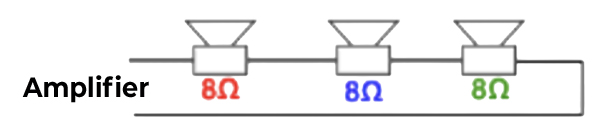 The calculation is simply: The calculation is simply:
Impedance = SPK1 + SPK2 + SPK3
In this case: 8Ω + 8Ω + 8Ω = 24Ω
If the speakers are connected in PARALLEL: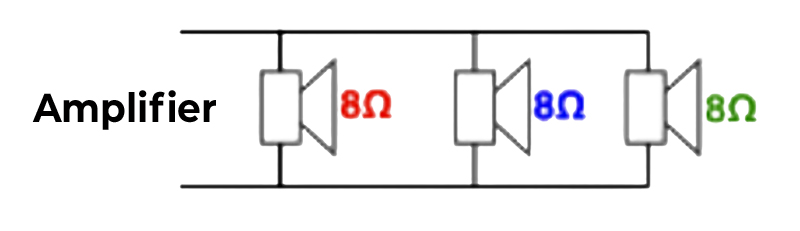 Calculating the impedance required a slightly different formula: Calculating the impedance required a slightly different formula:
Impedance = 1 ÷ (1 ÷ SPK1) + (1 ÷ SPK2) + (1 ÷ SPK3)
In this example: 1 ÷ (1 ÷ 8) + (1 ÷ 8) + (1 ÷ 8) = 2.66Ω
However, there is a shortcut: If in PARALLEL & all speakers are the same, take the separate impedance and divide it by the quantity:
3 x 8 Ω speakers in parallel: 8Ω ÷ 3 = 2.66Ω
If you're unsure whether to use 100V Line or Low Impedance for your project, click here to have a read of our blog post on the subject.
|